



Fiber Manufacturing Technology

Synthetic and Cellulosic Fiber Formation Technology
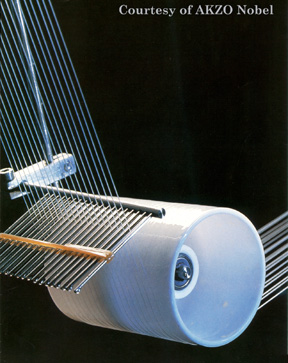 Most synthetic and cellulosic manufactured fibers are created by extrusion forcing a thick, viscous liquid (about the consistency of cold honey) through the tiny holes of a device called a spinneret to form continuous filaments of semi-solid polymer.
In their initial state, the fiber-forming polymers are solids and therefore must be first converted into a fluid state for extrusion. This is usually achieved by melting, if the polymers are thermoplastic synthetics (i.e., they soften and melt when heated), or by dissolving them in a suitable solvent if they are non-thermoplastic cellulosics. If they cannot be dissolved or melted directly, they must be chemically treated to form soluble or thermoplastic derivatives. Recent technologies have been developed for some specialty fibers made of polymers that do not melt, dissolve, or form appropriate derivatives. For these materials, the small fluid molecules are mixed and reacted to form the otherwise intractable polymers during the extrusion process.
 The Spinneret
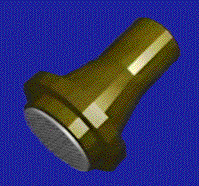
The spinnerets used in the production of most manufactured fibers are similar, in principle, to a bathroom shower head. A spinneret may have from one to several hundred holes. The tiny openings are very sensitive to impurities and corrosion. The liquid feeding them must be carefully filtered (not an easy task with very viscous materials) and, in some cases, the spinneret must be made from very expensive, corrosion-resistant metals. Maintenance is also critical, and spinnerets must be removed and cleaned on a regular basis to prevent clogging.
As the filaments emerge from the holes in the spinneret, the liquid polymer is converted first to a rubbery state and then solidified. This process of extrusion and solidification of endless filaments is called spinning, not to be confused with the textile operation of the same name, where short pieces of staple fiber are twisted into yarn. There are four methods of spinning filaments of manufactured fibers: wet, dry, melt, and gel spinning.
 Wet Spinning
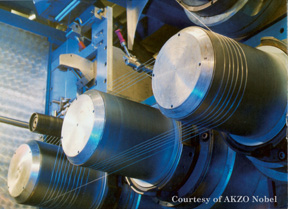
Wet spinning is the oldest process. It is used for fiber-forming substances that have been dissolved in a solvent. The spinnerets are submerged in a chemical bath and as the filaments emerge they precipitate from solution and solidify.
Because the solution is extruded directly into the precipitating liquid, this process for making fibers is called wet spinning. Acrylic, rayon, aramid, modacrylic and spandex can be produced by this process.
 Dry Spinning
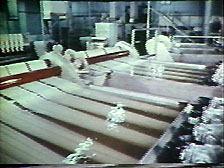
Dry spinning is also used for fiber-forming substances in solution. However, instead of precipitating the polymer by dilution or chemical reaction, solidification is achieved by evaporating the solvent in a stream of air or inert gas.
The filaments do not come in contact with a precipitating liquid, eliminating the need for drying and easing solvent recovery. This process may be used for the production of acetate, triacetate, acrylic, modacrylic, PBI, spandex, and vinyon.
 Melt Spinning
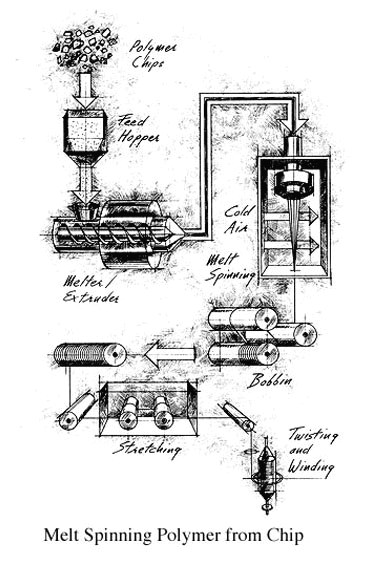
In melt spinning, the fiber-forming substance is melted for extrusion through the spinneret and then directly solidified by cooling. Nylon, olefin, polyester, saran and sulfur are produced in this manner.
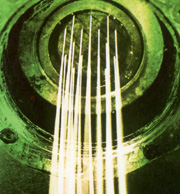
Melt spun fibers can be extruded from the spinneret in different cross-sectional shapes (round, trilobal, pentagonal, octagonal, and others). Trilobal-shaped fibers reflect more light and give an attractive sparkle to textiles.
Pentagonal-shaped and hollow fibers, when used in carpet, show less soil and dirt. Octagonal-shaped fibers offer glitter-free effects. Hollow fibers trap air, creating insulation and provide loft characteristics equal to, or better than, down.
Detailed production flowcharts:
Acrylic
Nylon (Polyamide)
Polyester
Gel Spinning
Gel spinning is a special process used to obtain high strength or other special fiber properties. The polymer is not in a true liquid state during extrusion. Not completely separated, as they would be in a true solution, the polymer chains are bound together at various points in liquid crystal form. This produces strong inter-chain forces in the resulting filaments that can significantly increase the tensile strength of the fibers. In addition, the liquid crystals are aligned along the fiber axis by the shear forces during extrusion. The filaments emerge with an unusually high degree of orientation relative to each other, further enhancing strength. The process can also be described as dry-wet spinning, since the filaments first pass through air and then are cooled further in a liquid bath. Some high-strength polyethylene and aramid fibers are produced by gel spinning.
Stretching and Orientation
While extruded fibers are solidifying, or in some cases even after they have hardened, the filaments may be drawn to impart strength. Drawing pulls the molecular chains together and orients them along the fiber axis, creating a considerably stronger yarn.

 Item Added to Cart
 Item Not Added